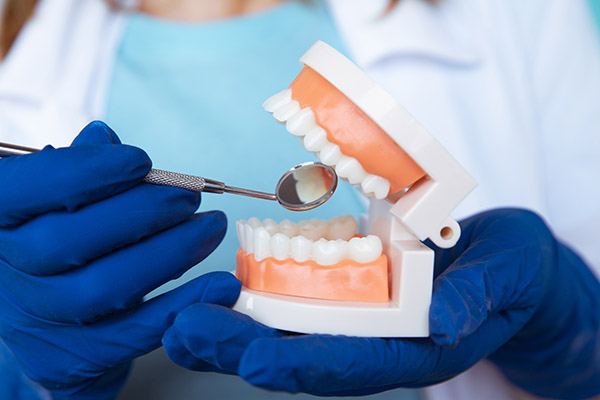
 A general dentist performs general dentistry services and can serve as the first point of contact for patients who need other types of dental care. Some services, such as dentures, may require a referral to a dentist who focuses on a specific area of dentistry.
General dentists vs. prosthodontists
The general dentist is usually responsible for preventative care, such as annual exams and tooth cleanings, and some tooth repair and cosmetic procedures, such as fillings and tooth whitening. A prosthodontist is a specific type of dentist who focuses on restoring missing teeth.
General dentists
All dentists must hold either a DDS (doctor of dental surgery) or DMD (doctor of dental medicine) degree, which requires three or more years of undergraduate education, plus four years of dental school. The primary focus of general dentistry services is the prevention of disease. General dentists offer a variety of services aimed at preventing disease and repairing damaged teeth:
- Preventative services, such as regular exams and teeth cleaning.
- Educational services, such as oral hygiene instructions.
- Restorative services, such as filling or extracting decayed teeth, repairing loosened or knocked-out teeth and treating gum disease.
- Cosmetic procedures, such as teeth whitening, dental bonding and porcelain veneers.
- Identifying health concerns, such as oral infections, sleep apnea, tobacco use and general health and wellness.
It is recommended that patients visit a general dentist at least once every six months for preventative care and whenever an acute issue occurs, such as tooth pain, bleeding gums or trauma. Some general dentists can assist with fitting dentures or refer patients to a prosthodontist.
Prosthodontists
Prosthodontists must complete three additional years of post-graduate education beyond the four years of dental school. Their area of focus is treating dental and facial problems that involve missing teeth. Treatments a prosthodontist may perform include dental implants, crowns, bridges, dentures and treatments for temporomandibular disorders.
Getting dentures
According to a study in the Journal of Prosthetic Dentistry, 37.9 million American adults will need dentures in 2020. The process of getting dentures usually begins with an examination by a general dentist, who may then refer patients to a prosthodontist for further evaluation.
Process
A prosthodontist begins by examining the patient and determining if dentures are a recommended treatment option. If dentures are needed, then the next step is to design a prosthetic that properly fits the patient's mouth and achieves the cosmetic appearance the patient desires.
To achieve the proper fit, the dentist first takes measurements and impressions of the patient's jaw. Those impressions are used to create a model that is placed in the patient's mouth and adjusted to achieve the desired fit and look. The adjusted model is used as the basis to make a set of dentures. This process can take a few months to complete.
Check out what others are saying about our dental services on Yelp: General Dentistry Services in San Francisco, CA.
Conclusion
A general dentist is a good place to start for patients who may need dentures. A dentist providing general dentistry services can recommend treatments and provide a referral for any services that may need to be performed by a prosthodontist or other dental professional.
Request an appointment or call Serenity Dental Spa at 415-376-6196 for an appointment in our San Francisco office.
Related Posts
More than likely, you have had a dental checkup multiple times in your lifetime. So, you know a hygienist cleans the teeth and a dentist performs an oral examination. You also understand that either a hygienist or a technician takes X-rays during the visit. However, have you ever wondered just how important the X-rays are?…
You might wonder when you need to have a dental checkup since it is critical to your oral health. Taking care of the teeth is one of the most significant steps in maintaining your health. That is why getting an appointment every six months is a good starting point. Keep reading to learn more about…
If you go to a dental clinic for a dental checkup, the dentist offers all kinds of treatment options. However, many of those treatments are common. That means dentists see patients every day for the same types of issues. Keep reading to learn more about these common treatments.A dentist has the knowledge and training to…